E-Jet systems
E-Jet E1 vs E2: the cockpit differences that matter
Inside, the E2 looks like an E1, and that was on purpose. But flight controls, displays, engines and many system details changed. Here is the summary, limited to what you can check in public sources.
In short
- The E1 and E2 share a pilot type rating designator in the Canadian authority’s evaluation, but going from the E1 to the E2 requires differences training.
- On the E2, flight controls are closed-loop fly-by-wire on all three axes, with envelope protection, and five portrait displays became four larger landscape ones.
- Geared engines, redesigned landing gear and new power-up and procedure details complete the list.
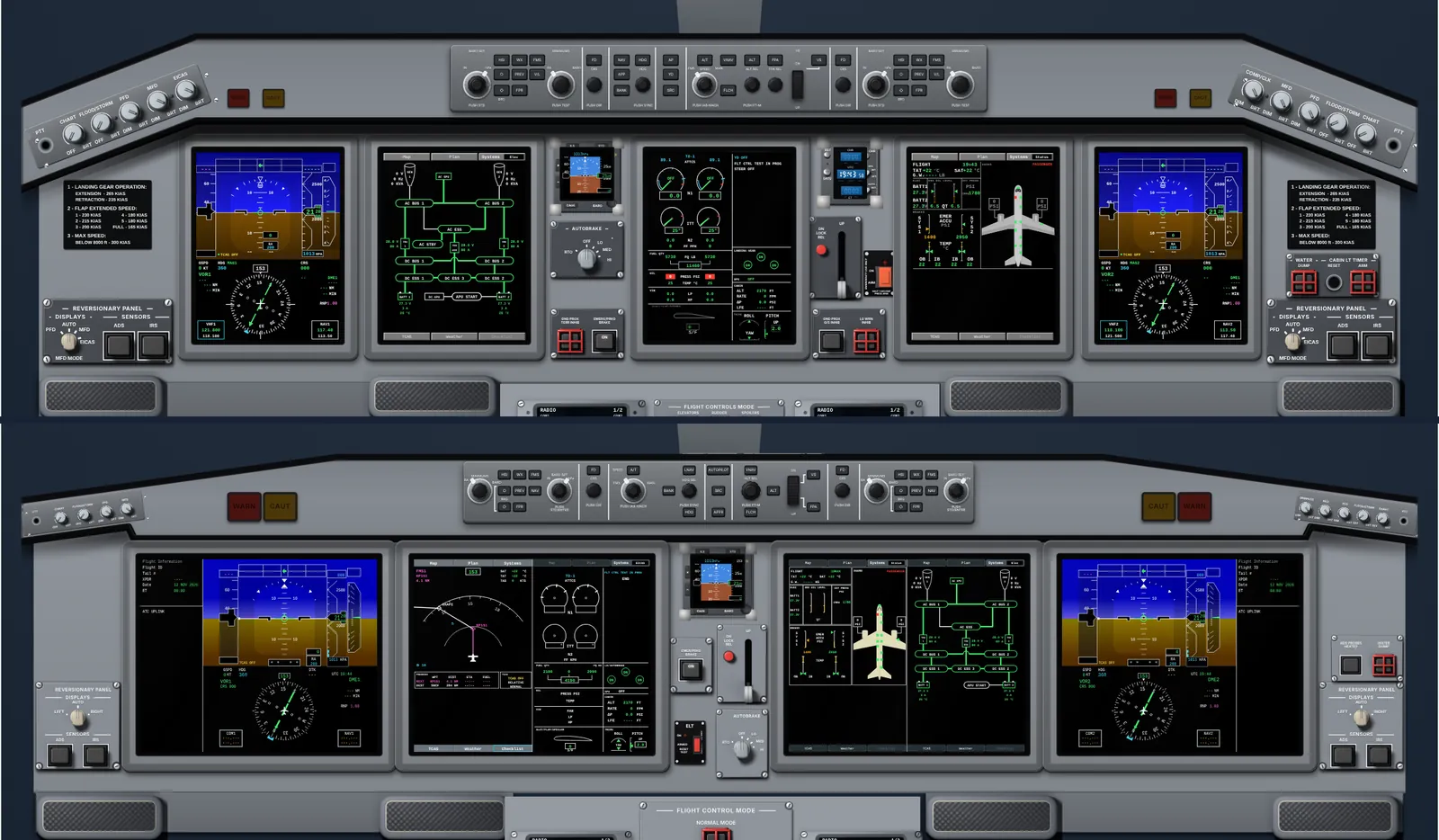
The second-generation E-Jets, the E190-E2 and E195-E2, received type certification from the Brazilian, US and European authorities in early 2018, starting with the E190-E2. The manufacturer’s goal was to keep the pilot interface close to the E1’s, to ease the transition, while changing a lot underneath.
This summary is based mainly on the operational evaluation report published by Canada’s civil aviation authority, which compares the two generations item by item. Where there is no clear public source, this article does not make the claim.
Important: this article is study material. Always follow your operator’s approved manuals and procedures; your airline’s sequence, checks and division of duties have the final word.
Type rating and differences training
In the Canadian report, every E-Jet variant, from the E170 to the E195-E2, sits under the same pilot type rating designator. That does not mean an E1 pilot can fly the E2 the next day: the authority requires ground and flight differences training from the E1 to the E2, at a level that calls for a simulation device. The reverse direction, E2 to E1, was not evaluated in that report.
Other authorities have their own reports and rules. What applies to you is your authority’s rule and your operator’s training program.
Flight controls: closed-loop fly-by-wire
This is the biggest conceptual change. The E1 already had fly-by-wire controls, with normal and direct modes. On the E2, the architecture became full closed-loop fly-by-wire on all three axes: the ailerons are now electronically controlled too, with spoileron logic, and normal mode gained control laws with full envelope protection.
- Closed-loop means, simply put, that the computer compares what the airplane is doing with what the pilot asked for and keeps correcting the difference.
- The E2 flight control mode panel has a single normal mode button for all three axes.
- With the autopilot engaged, the E2 control column does not move: the autopilot servos that moved the column were removed.
- The E1 pitch trim runaway procedure no longer exists on the E2, according to the same report.
For the pilot, this changes the handling feel, some non-normal procedures and what you expect to see and feel during training maneuvers.
Displays: four larger screens
The E1 has five portrait displays of 8 by 10 inches: two PFDs, two MFDs and EICAS in the middle. The E2 has four landscape displays of 13 by 10 inches, with the ability to split the screen into windows. In practice, the map, vertical profile, synoptics and lists get more room, and where each piece of information appears changes.
Power-up differs too: the Canadian report notes that, on battery-only power-up, different displays are available on the E2, and that the electrical power-up built-in test takes about two minutes on the E2 versus three on the E1.
FMS and MCDU
The FMS concept is the same, and pilots coming from an E1 with the Next Generation FMS recognize the main pages. MCDU screen differences and cursor control device (CCD) differences appear as differences training topics. Comparing the same concept in both trainers, the holding page has the same idea and a slightly different layout:
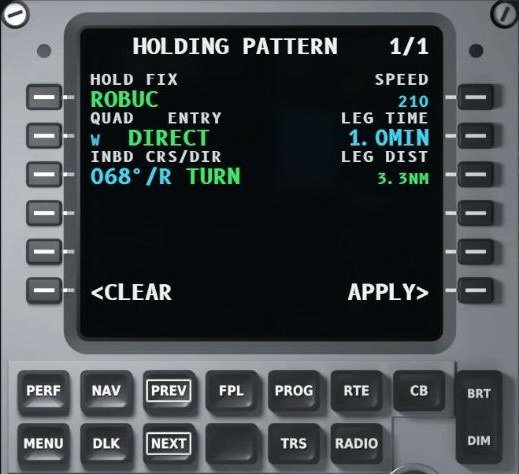 | 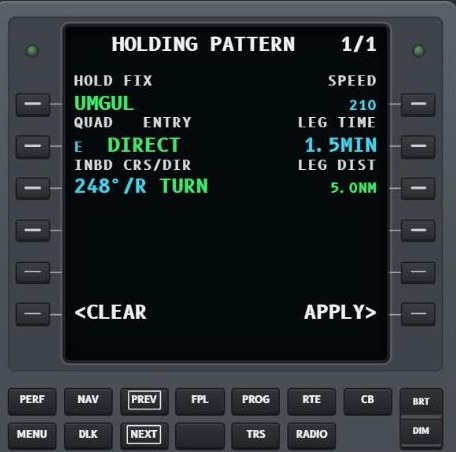 |
| E1 (E175 trainer) | E2 (E2 trainer) |
See the walkthrough for each in E175 FMS step by step and E2 MCDU step by step.
Engines
The E2 uses ultra-high-bypass turbofans with a gear-driven fan (geared turbofans) in place of the E1’s turbofans. For the crew, the Canadian report lists, among other items: a fan vibration indication, an assisted engine start indication, an additional takeoff thrust mode and thrust reversers with blocker doors instead of a translating cowl.
Wing, landing gear and other systems
- Wing and tail: the E2 has a new wing, single-slotted flaps and a smaller horizontal stabilizer.
- Landing gear: trailing-arm main gear and more fuselage ground clearance.
- Brakes: RTO selection on the autobrake is baseline equipment on the E2.
- Cockpit items: changes to the audio panel, the location of emergency equipment and check items on the fuel panels.
What does not change
The cockpit philosophy, the general overhead layout, the alerting logic and the way the crew works together stay very close. Just compare the overhead in both trainers. That is why the transition is handled as differences and not as a new airplane. But a small difference in a switch you look for under pressure is still a difference: study the airplane you will fly.
Frequently asked questions
Do the E1 and E2 share a type rating?
In the Canadian authority’s evaluation, yes: the designator is the same, but going from the E1 to the E2 requires differences training. Check your authority’s and your operator’s rules.
Wasn’t the E1 already fly-by-wire?
It was, with normal and direct modes. The E2 moved to a full closed-loop fly-by-wire architecture on all three axes, ailerons included, with envelope protection.
How many displays does the E2 flight deck have?
Four landscape displays of 13 by 10 inches, in place of the E1’s five portrait displays of 8 by 10 inches.
Is the E2 FMS different?
The concept is the same, but the MCDU screens and cursor control have differences covered in training. Study the version you will fly.
Flying the E1? See the E-Jet E1 trainer →
Sources
- Transport Canada. Operational Evaluation Report, Embraer E170 (E-Jets), revision 1, which adds the ERJ 190-300 (E190-E2) and ERJ 190-400 (E195-E2): type rating designator, differences training level and differences tables.
- E190-E2 type certification by ANAC, FAA and EASA in February 2018 (public announcements at the time).